
Wisconsin Financial Literacy Statistics
In Wisconsin, the Financial Educators Council (WFEC) studies and tracks financial wellness indicators affecting residents across the state. These data are routinely reviewed and published here to ensure that they remain current. The information supports the efforts of policymakers, organizations, individuals, and all other stakeholders championing financial education. Driving forward momentum for the financial wellness agenda remains a core objective, and maintaining these statistics is one method by which we achieve that goal.
Cost of Financial Illiteracy Survey
Wisconsinites report that lack of financial knowledge carries a high cost, according to the NFEC’s most recent survey. Participants across the state responded to the single question: “During the past year, about how much money do you think you lost because you lacked knowledge about personal finances?” The results are shown below. Since 2017, the NFEC has conducted this annual survey, consistently revealing that the average individual cost of financial illiteracy approaches or exceeds $1,000 per person – with estimated national losses reaching into the hundreds of billions of dollars each year, and losses in the hundreds of millions across Wisconsin.
Cost of Financial Illiteracy
$0 – $499
$500 – $999
$1,000 – $2,499
$2,500 – $9,999
$10,000 +
Wisconsin Financial Vulnerability
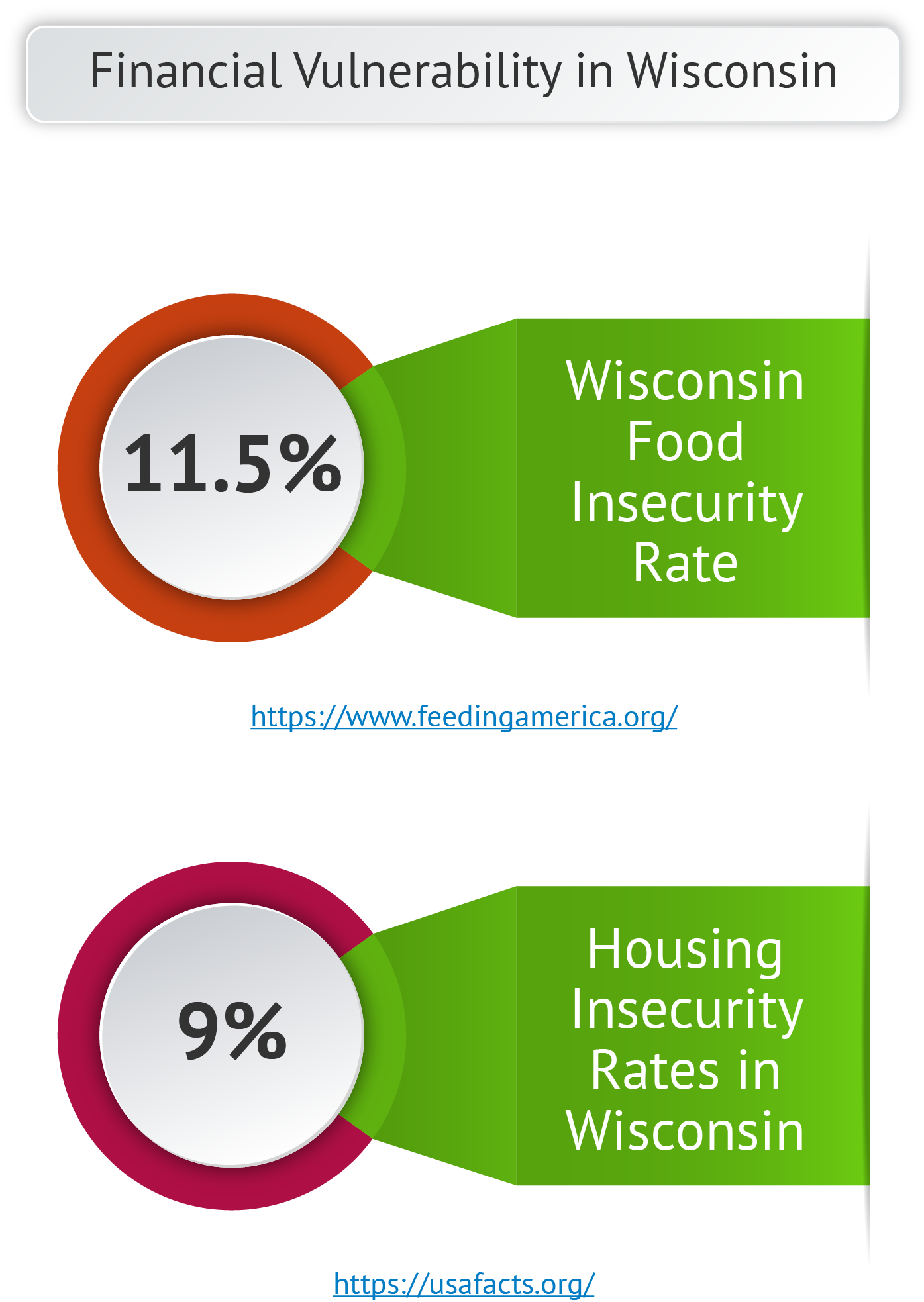
Financial vulnerability across America is assessed using two primary metrics: food insecurity and housing insecurity. The nonprofit Feeding America collects data regarding food insecurity state-by-state. In Wisconsin, Feeding America finds that one in every eight residents – and one in six children – is currently facing hunger. Expressed numerically, that’s 694,710 total individuals, or 11.5% of the population; and 202,600 children. The organization calculates that it would take more than $463 million per year to meet the food needs of these food-insecure Wisconsinites.
As regards housing insecurity, the World Population Review (WPR) reported that there were 5,049 unhoused individuals living in Wisconsin in 2024, representing a homeless rate of 9%. That figure had gone down by 10.6% since 2007. WPR estimates that there are over half a million homeless people living across the U.S., and defines “homeless” as those who “live in a temporary shelter or transitional housing or sleep in a place not meant for habitation (like an abandoned building).”
Data Describing Wisconsinites’ Financial Situations
Average Total Consumer Debt
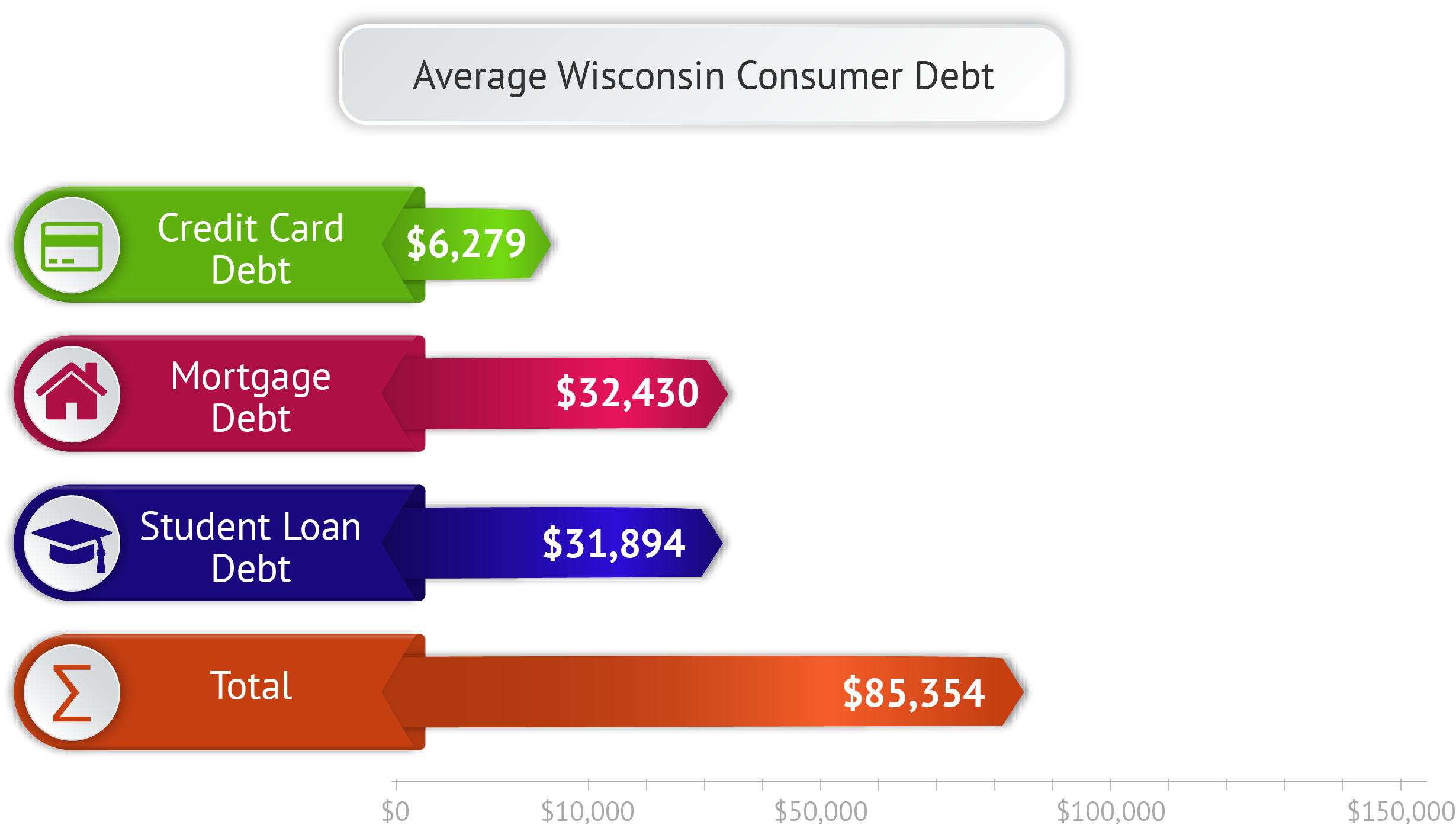
Total consumer debt in the United States rose above $18 trillion by the end of 2025. Wisconsin residents struggle with this issue as well, according to data published by Experian – their report indicates that Wisconsinites with consumer debt held an average balance of $85,354 in 2025. While that figure seems high, it sits well below the national average of $104,755 and had decreased modestly (–0.3%) from 2024.
Wisconsin Debt by Category
People with student loan debt in Wisconsin hold an average outstanding balance of $31,894, according to further research by the World Population Review. WalletHub reports that Wisconsin credit card users owed an average of $6,279 on those cards as of 2026. And additional data from the World Population Review calculates the average mortgage debt in Wisconsin at $32,430.
Statistics on Wisconsin Financial Literacy Education and Policy
The National Education Association (NEA) releases a periodic report summarizing the total number of school districts, student enrollments, and teachers employed by each U.S. state. The most recent report was published in 2025; it indicated that in Wisconsin, there were 449 operating public school districts during the 2023-2024 academic year. Student enrollments totaled 814,002 that same year; and the total number of teachers employed was 55,890. That resulted in a ratio of 14.6 pupils to each teacher.
Regarding state financial literacy policy, Wisconsin Act 94 (Assembly Bill 280) – enacted in 2017 – requires that each school board “adopt academic standards for financial literacy and incorporate instruction in financial literacy into the curriculum in grades kindergarten to 12.” In 2021, Executive Order #106 renamed the Wisconsin Governor’s Council on Financial Literacy (created under 2011 Executive Order #24) as the Governor’s Council on Financial Literacy and Capability. Part of the Council’s mission is to “Explore and identify best practices in implementing financial literacy and capability through individuals’ life stages – pre-K to college, young adult, adulthood, pre-retirement, and retirement.”
In December 2023, the Wisconsin State Legislature passed Act 60, which mandates that high school students must complete at least one half-credit of personal financial literacy to graduate. The curriculum must cover essential topics including financial mindset, education and employment, money management, saving and investing, credit and debt, and risk management and insurance. This mandate applies beginning with the graduating class of 2028.